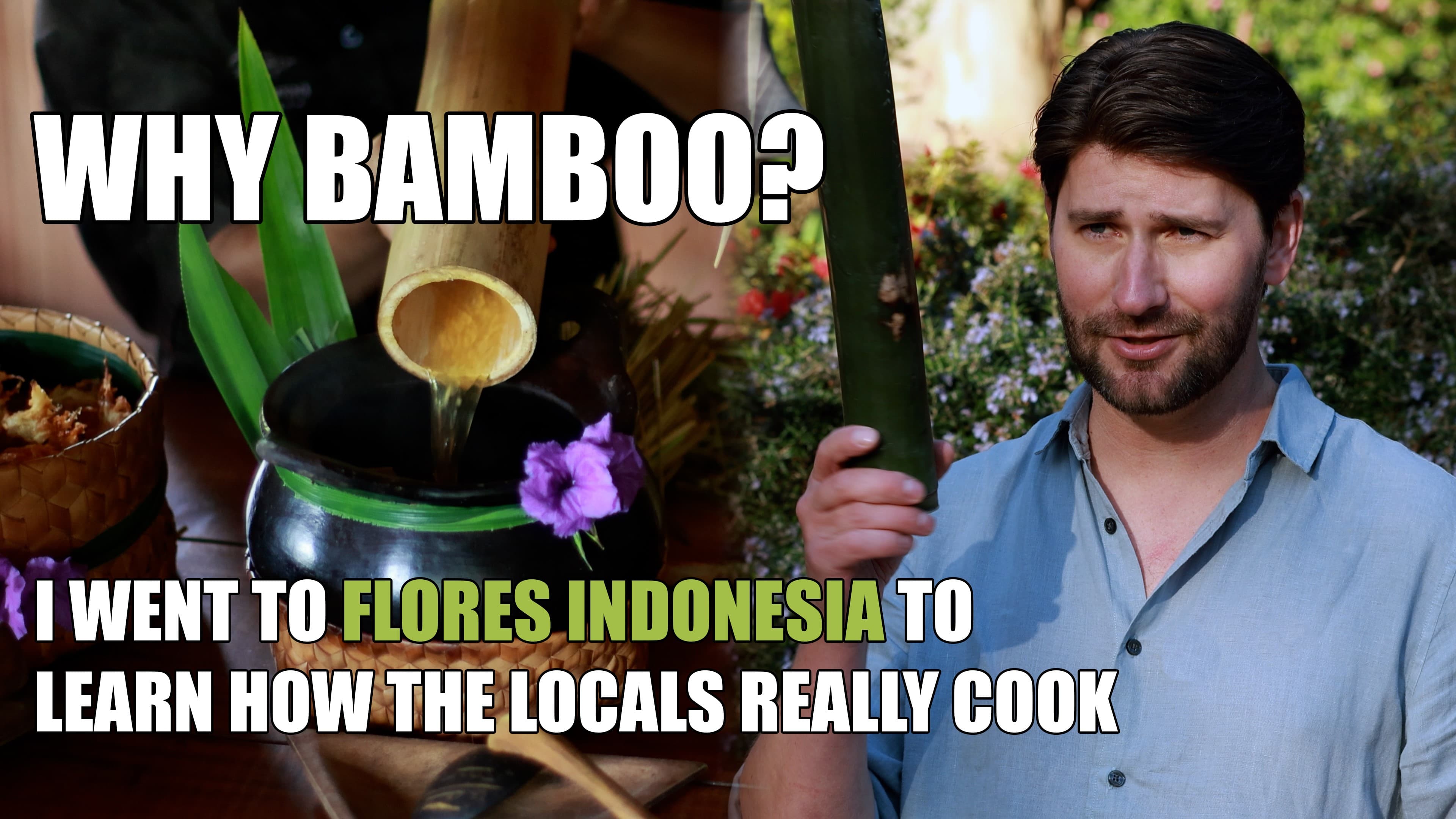
Bamboo and Fire: I Went to Flores Indonesia to Learn their Traditional Cooking Methods
Welcome to the very first installment of Cooking From the Ground Up. I’m Matthew Neville, and for a long time, I’ve dreamed of a space where we can dive deeper into the roots of what we eat. Food isn’t just fuel; it is a living history, a cultural map shaped by place, tradition, and the hands of those who came before us. My mission is to talk to the growers, the keepers of tradition, and the home cooks who hold secret recipes that have never seen a drop of ink—recipes passed down through generations by word and by taste.
On this inaugural journey, I traveled to the rugged and beautiful island of Flores, Indonesia. I went there to find traditional Flores cooking methods that are slowly being lost to time. My guide was a remarkable woman named Liz, the founder of Dapur Tara, who has dedicated her life to studying the indigenous foodways of this land. From the crackle of bamboo in an open fire to the rhythmic tuk-tuk of the mortar and pestle, this trip changed how I view the relationship between the earth and the plate. Now, back in my outdoor kitchen in Australia, I’m reflecting on those flavors and teaching you how to bring a piece of Flores into your own home.
The Cape of Flowers: A Brief History of Flores
Flores is a stunning Indonesian island located just east of Bali. Its name, Cabo de Flores (the Cape of Flowers), was bestowed by 16th-century Portuguese traders who arrived in search of the world’s most valuable spices. While most modern travelers fly into Labuan Bajo to head out to Komodo Island for diving, I was pulled inland toward the smoke of traditional kitchens.
The culinary landscape here is defined by its isolation and its connection to tribal identity. In Flores, food is still deeply intertwined with ceremony and offering. As Liz explained to me, the way a tribe touches food or prepares an offering varies from village to village, but the core remains the same: a reverence for the ingredients provided by the land.
Meeting Kaka Liz at Dapur Tara
My journey led me to Dapur Tara, a sanctuary for indigenous food. It was here that I met Kak Liz, a woman whose knowledge of traditional Flores cooking methods is unparalleled. Liz isn’t just a cook; she’s a guardian of "forgotten food" and "forgotten seeds." She spends her time finding ancient varieties of plants and bringing them back to life in the soil of her farm.
"Plants are growing because they know we need them," Liz told me. Her perspective is holistic; she is also a midwife, and she combines her knowledge of botany with her experience in maternal health. In Flores, food is medicine. Turmeric isn’t just a spice for color; it’s an antiseptic and an anti-inflammatory. Ginger and lesser ginger (kencur) are used to balance the body.
The morning of our lesson was punctuated by a literal shake-up—a significant earthquake that sent us all running from the buildings. In Flores, life is lived in close proximity to the volatile power of nature. But as the dust settled and we realized we were safe, the people of the farm simply went back to work. It was a humbling reminder that these traditions have survived far worse than a morning tremor; they are as resilient as the people who keep them.
Core Techniques: Bamboo, Smoke, and Clay
When we talk about traditional Flores cooking methods, three elements dominate: bamboo, smoke, and clay. Before modern stovetops, these were the tools of every household.
1. Cooking in Bamboo (Tibu and Holo)
Using green bamboo as a vessel is perhaps the most iconic technique in Flores. The bamboo acts as a pressure cooker, a steamer, and an aromatic flavoring agent all at once. Because the bamboo is fresh and full of moisture, it doesn't burn through immediately; instead, it slowly chars, infusing the contents with a subtle, woody sweetness. This is how Tibu (chicken) and Holo (rice) are traditionally prepared.
2. Smoking as Preservation
In a tropical climate, preservation is vital. Smoking is one of the oldest methods used in Flores to keep fish, chicken, and even palm sugar shelf-stable. The smoke adds a depth of flavor that defines the regional palate. During my visit, I tasted smoked palm sugar that had a complexity I had never experienced—rich, earthy, and deep.
3. The Tuk-Tuk Sound
Liz taught me that "if your kitchen is silent, you aren't cooking." The tuk-tuk is the sound of the mortar and pestle (cobek and ulekan). In Flores, you don't use a blender. You pound. You grind. This physical process releases oils and aromatics in a way that high-speed blades never can.
Bringing Flores to the Australian Backyard
Returning to Australia, I was determined to see if these traditional Flores cooking methods could be replicated using what I had. I fired up my outdoor pizza oven to mimic the intense, dry heat of an Indonesian fire pit and set out to forage and harvest what I could.
Finding the right ingredients was a challenge, but a rewarding one. I harvested kaffir lime leaves from my own tree and managed to source pandan leaves and kencur (lesser ginger) from specialty grocers. Sourcing fresh bamboo is the biggest hurdle for most, but if you can find a clean, green source, the results are transformative.
Traditional Flores Recipes: A Step-by-Step Guide
The Foundation: Sambal (Flores Style)
Every table in Flores features a signature sambal. It is the beginning and the end of every meal. For this version, we roast the ingredients first to bring out a smoky sweetness.
- Ingredients: Tomatoes, shallots, bird's eye chilies, palm sugar, and salt.
- Method: Roast the whole tomatoes, shallots, and chilies in the fire (or a very hot oven) until charred and soft. Transfer them to a mortar and pestle. Add a pinch of salt and a healthy chunk of palm sugar. Pound until you have a coarse, vibrant paste.
Holo: Bamboo Sticky Rice
This was one of the most unique things I tasted. The rice is infused with the scent of banana leaves and the subtle aroma of the bamboo itself.
- Prepare the Spice Paste: Grind turmeric, ginger, garlic, lemongrass (white part only), and pandan leaf into a fine paste.
- Make the Spiced Milk: Mix the paste with fresh shredded coconut and a little water. Squeeze the mixture through a strainer to create a vibrant, yellow, aromatic coconut milk.
- Line the Bamboo: Take a segment of green bamboo and line the inside with a banana leaf. This prevents sticking and adds flavor.
- Fill and Cook: Fill the bamboo with soaked glutinous rice (sticky rice) and pour in the spiced coconut milk until it covers the rice. Seal the top with a plug of banana leaf.
- The Fire: Place the bamboo directly into the coals of your fire. Rotate it occasionally. It’s done when the bamboo is charred on the outside and the rice is tender and fragrant.
Tibu: Bamboo Chicken Curry
Unlike a traditional pot curry, Tibu is dry-cooked in the bamboo, allowing the chicken to braise in its own juices and the aromatics.
- The Marinade: Rub chicken pieces with lime juice and salt. Let it sit for 15 minutes.
- The Aromatics: Create a paste of turmeric, ginger, garlic, pepper, and ground coriander. Toss the chicken in this paste, adding sliced lemongrass and kaffir lime leaves.
- The Cook: Stuff the marinated chicken into a bamboo tube. No water is needed—the moisture from the chicken and the green bamboo creates a perfect steaming environment. Place in the fire for about 30–40 minutes.
Tempe Tuk Tuk: Smashed Tempeh Patties
Tempeh is uniquely Indonesian, and this "smashed" version is a revelation for those used to simple stir-fried tempeh.
- The Spice: Grind kencur (lesser ginger), garlic, coriander seed, salt, and kaffir lime leaf.
- The Tuk Tuk: Smash the raw tempeh directly into the spice paste using the mortar and pestle until it forms a moldable dough.
- Fry: Form the mixture into small, flat patties and fry in hot oil until golden and crispy on the outside.
Reflections from the Ground Up
Attempting these traditional Flores cooking methods in my own backyard was a struggle. Cooking with fire is unpredictable; the bamboo can crack, the heat can be uneven, and the timing is never exact. But as I cracked open that charred bamboo and the steam of turmeric and pandan hit my face, I realized that the struggle is part of the flavor.
In Flores, cooking isn't a chore; it's a connection to the ancestors. When Kak Liz shares a recipe, she isn't just sharing a list of ingredients; she is sharing the survival of her people. By learning these techniques, we help keep those "forgotten seeds" alive. We acknowledge that the best food doesn't come from a packet or a high-tech kitchen—it comes from the ground up.
I hope this inspires you to look at your own ingredients differently. Maybe you don't have a bamboo forest in your backyard, but you can still use a mortar and pestle. You can still roast your vegetables over a flame. You can still seek out the history of the food on your plate. Until next time, keep cooking, keep exploring, and stay grounded.
Final Tips for Fire Cooking
- Use Green Bamboo: Never use dried bamboo for cooking; it will catch fire instantly. Fresh, green bamboo contains the moisture necessary to steam the food.
- Patience is Key: Fire cooking takes longer than a gas stove. Enjoy the process.
- Don't Skip the Banana Leaf: It acts as a natural non-stick coating and provides a floral aroma that is essential to the authentic taste of Flores.
Enjoy the show? Subscribe to the channel!
Follow Cooking From the Ground Up for more documentary-style food adventures from around the world.